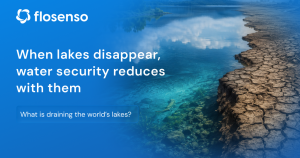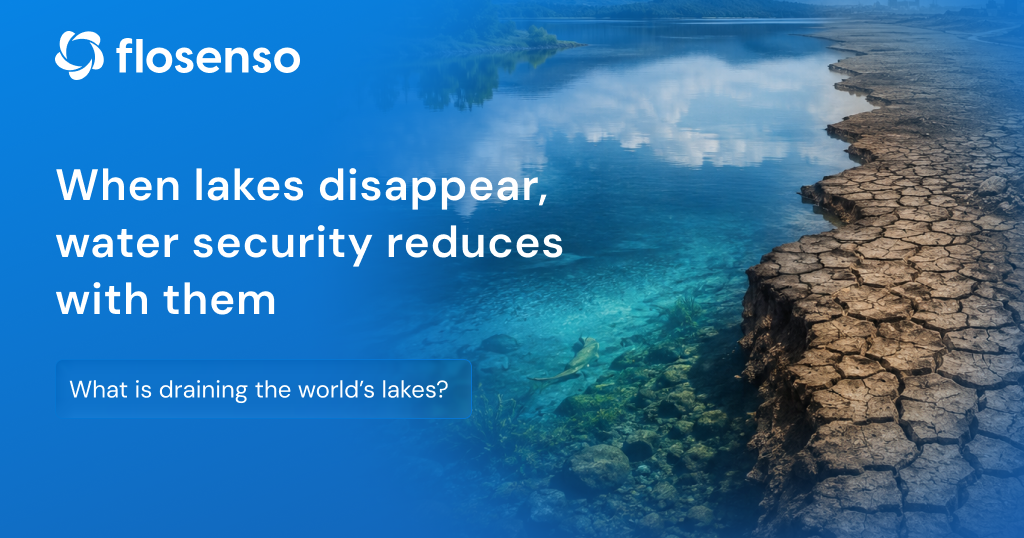
Lake Urmia in Iran has repeatedly shrunk into vast salt flats. The Great Salt Lake in the US has exposed hundreds of square miles of lakebed. The Caspian Sea is steadily retreating. In August 2026, Lake Mead, a major reservoir in the United States, fell to its lowest level since it was created nearly 90 years ago.
Several such cases have been reported across the globe. A landmark study published in Science analysed nearly 2,000 of the world’s largest lakes and reservoirs. It found that 53% experienced significant declines in water storage between 1992 and 2020. The rise of drying lakes is becoming one of the clearest signs of a much wider global water crisis.
But, how does something as large as a lake begin to disappear? What is drying up the lakes globally? Lakes do not disappear simply because one summer was too hot or one rainy season failed. Their decline often begins much earlier, when climate pressure, rising water demand, damaged wetlands, river diversion and groundwater depletion slowly push an entire water system out of balance.
Let us ponder over the reasons behind drying lakes around the world.
Why are freshwater lakes and rivers drying up around the world?
Drying rivers and shrinking freshwater lakes are often symptoms of the same stressed water system. Rivers, lakes, wetlands and aquifers are connected, so pressure on one can affect the others.
A lake may depend on a river that begins hundreds of kilometres away. That river may depend on rainfall, mountain snow and groundwater. If large volumes of water are diverted upstream for farms, industries or cities, less reaches the lake.
At the same time, groundwater depletion can reduce the underground flows that keep rivers running during dry periods.
Wetland loss makes matters worse. Healthy wetlands slow rainwater down. They store it, filter it and release it gradually. When wetlands are drained, encroached upon or built over, rainwater moves away faster instead of supporting groundwater recharge.
The chain can become simple and dangerous:
- Less groundwater recharge
- Lower river flow
- Less water reaching lakes
- Shallower lakes
- Faster warming and evaporation
So, the story of drying rivers and lakes is really a story about how the entire freshwater cycle is being disrupted.
Is climate change causing lakes to disappear?
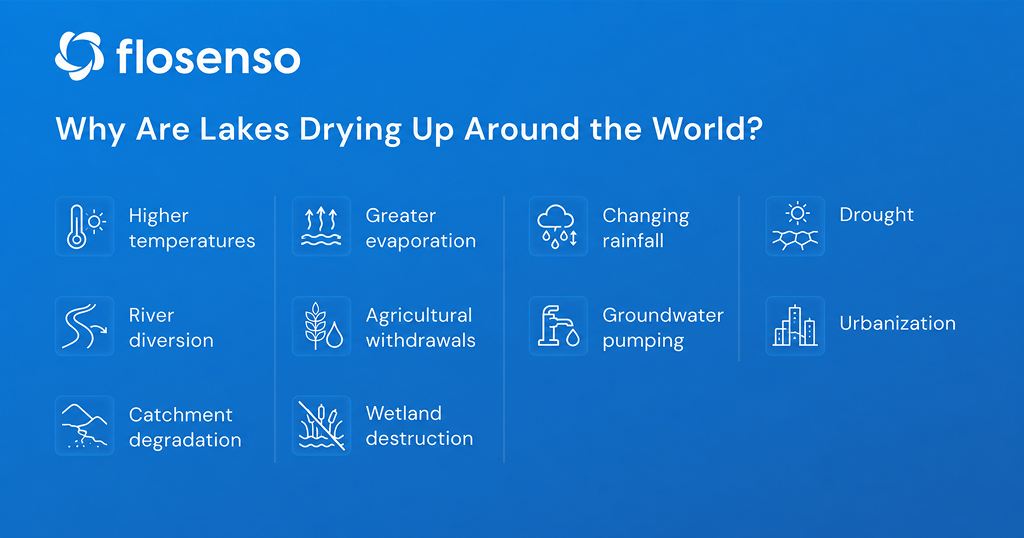
Climate change is an important reason many lakes are under pressure, but it is not acting alone. Human water consumption often makes already stressed lakes far more vulnerable.
Higher temperatures increase lake evaporation. Warmer winters can reduce snowpack in mountain regions. Snow may also melt earlier, sending water downstream before it is needed most during the hotter months.
Longer droughts can reduce groundwater recharge. Meanwhile, irregular rainfall can make lake inflows less predictable. Large climate patterns can add further pressure. The El Nino effect, for example, changes rainfall and temperature patterns across many parts of the world. In some regions, it can contribute to drought and extreme heat. In others, it may bring unusually heavy rain.
Research has also shown that global lake evaporation is increasing as the climate warms. But climate change alone does not explain every shrinking lake. Lake Urmia in Iran is a good example. Drought and higher temperatures have played a role, but so have agricultural irrigation, dams and reduced river inflows.
Therefore, climate change makes the water balance harder to maintain. Human decisions often decide how quickly that balance breaks.
Are we taking too much water before it reaches lakes?
In many regions, yes, we are consuming more. A lake may be the most visible part of a water system, but the decisions affecting it often happen far upstream. Water is often diverted for agriculture, cities, industries, reservoirs and power generation before it ever reaches the lake downstream. Agriculture has the biggest footprint. According to FAO, agriculture accounts for roughly 72% of global freshwater withdrawals.
The Aral Sea shows what can happen when too much river water is taken upstream. Once one of the world’s largest inland water bodies, the Aral Sea collapsed after enormous quantities of water from the rivers feeding it were diverted for irrigation. As the lake retreated, fisheries disappeared. Communities lost livelihoods. Exposed sediments became sources of salt and contaminated dust.
This story carries an important lesson. The lake may be downstream, but the problem can begin hundreds of kilometres away.
How does groundwater depletion make lakes shrink?
Groundwater and lakes are often connected. Groundwater depletion can reduce the underground water that supports lakes, wetlands and rivers. When aquifers are pumped faster than they recharge, the effects can spread across the entire landscape. Excessive pumping can lower the water table, reduce the groundwater feeding a lake and, in some cases, even pull lake water towards the depleted aquifer.
We often think of a borewell and a lake as completely different water sources. Hydrologically, that is not true. Groundwater naturally moves through the landscape. In many places, it slowly feeds streams, wetlands and lakes, especially during dry periods. But when thousands of wells begin pumping from the same aquifer, groundwater levels fall. Less water reaches the lake.
Sometimes the flow can even reverse. Instead of moving from groundwater to the lake, the system begins moving from the lake to the depleted groundwater. That means groundwater pumping far from the shoreline can still affect a lake. This is why groundwater recharge is so important to long-term water security.
The borewell and the lake may look like two different wallets. Underground, they may be spending the same money.
Is this a warning from the lakes about the future?
Yes. The shrinking lakes are a warning to the world. The world is drying up.
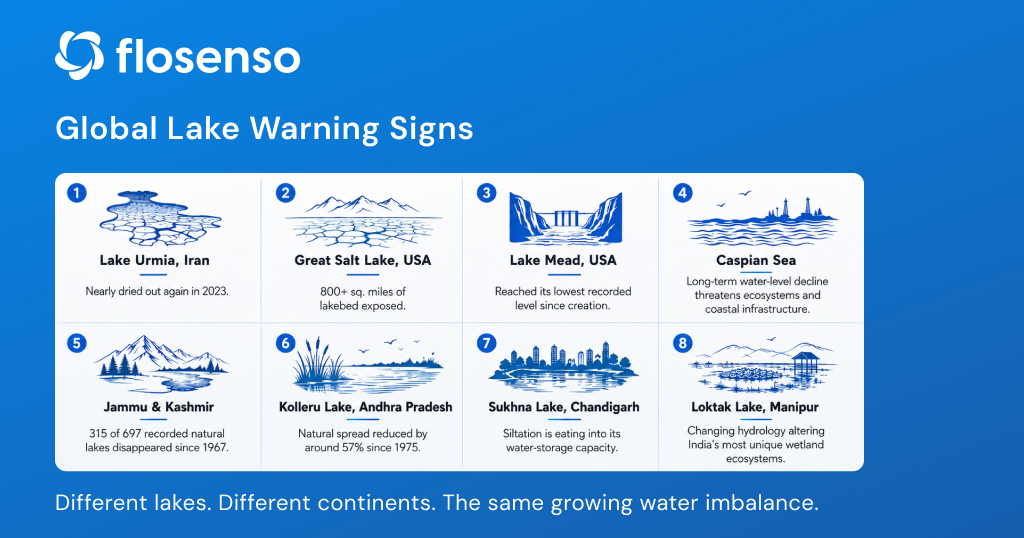
There is no reliable global ranking of the “fastest dying lakes”. Different water bodies are measured by water level, volume, area, salinity or ecological health. However, some major examples show what long-term water imbalance can look like.
Lake Urmia, Iran
It was once one of the world’s largest salt lakes. NASA reported that it nearly dried out in autumn 2023, leaving large areas of exposed salt. Drought contributed to the decline, but so did dams, irrigation and groundwater extraction. The lake shows what happens when climate stress and heavy water demand collide.
Great Salt Lake, USA
This lake has shrunk dramatically because of long-term water diversions, drought and warming. Its decline has also created another problem: dust. Utah authorities report that more than 800 square miles of lakebed have been exposed. As the sediment dries, strong winds can carry fine particles into surrounding communities.
Some sediments contain substances such as arsenic, making lake decline a potential public-health problem as well as a water problem.
The Caspian Sea
Even the world’s largest inland water body is vulnerable. The Caspian Sea has been steadily retreating, and scientists warn that continued decline could affect ports, coastal communities, wetlands and wildlife. Higher temperatures are increasing evaporation, while changing river flows add further pressure. Its sheer size cannot protect it from a long-term water imbalance.
Lake Mead, USA
Lake Mead is a reservoir rather than a natural lake, but it has become one of the clearest symbols of water stress in the American West. On 9 August 2026, its water level fell to around 1,040 feet above sea level, the lowest since the reservoir was created. Long-term pressure on the Colorado River, drought, heat and poor snowpack have all contributed. Millions of people, farms and industries depend on this river system.
Dal and Wular Lake, India
This problem is not limited to distant countries alone. A 2026 audit reported that 315 of 697 natural lakes recorded in Jammu and Kashmir had disappeared since 1967, while another 203 had significantly shrunk. Dal Lake and Wular Lake continue to face pressure from pollution, encroachment, sedimentation and changing hydrology.
Kolleru Lake in Andhra Pradesh has also lost a significant part of its historic spread, with aquaculture and encroachment among the major pressures. Chandigarh’s Sukhna Lake faces siltation and declining storage capacity. Manipur’s Loktak Lake presents a different kind of warning. The lake still contains water, but changes in water levels, agriculture, settlements, pollution and hydropower regulation are altering its ecological system.
Together, they add another layer to the growing concern around water shortage in India. Pollution, encroachment, sedimentation, changing hydrology and climate pressures have all contributed. When hundreds of lakes decline in a single region, it is not just a lake problem. It is a water-system problem.
Why is water shortage in India becoming a growing concern?
Water shortage in India is becoming a growing concern because rising demand, groundwater extraction, pollution, rapid urbanisation and uneven rainfall are putting increasing pressure on freshwater resources.
India receives substantial rainfall, but much of it arrives during a relatively short monsoon season. The real challenge is retaining that water. Lakes, ponds, wetlands and open soil have traditionally played an important role in storing rainfall and allowing it to recharge the ground.
As cities expand, many of these areas are paved, built over or disconnected from natural drainage systems. That helps explain an increasingly familiar contradiction. A city can flood during the monsoon and still face a water shortage a few months later.
Wetlands are particularly important because they act like natural sponges. They hold excess rain, reduce flooding, filter pollutants and help water slowly help in groundwater recharge. Yet wetlands continue to disappear worldwide.
The 2025 Global Wetland Outlook estimates that around 22% of global wetland area has been lost since 1970. This helps explain an increasingly familiar contradiction, which says “A city can be flooded in August and struggling with water scarcity by April.”
More rainfall does not automatically mean more usable water. What matters is how much water the landscape can retain.
Rainfall happened. But not enough of it stayed. No groundwater recharge. Groundwater depletion. Waer shortage. That weakens water security.
Can drying lakes cause water shortage globally?
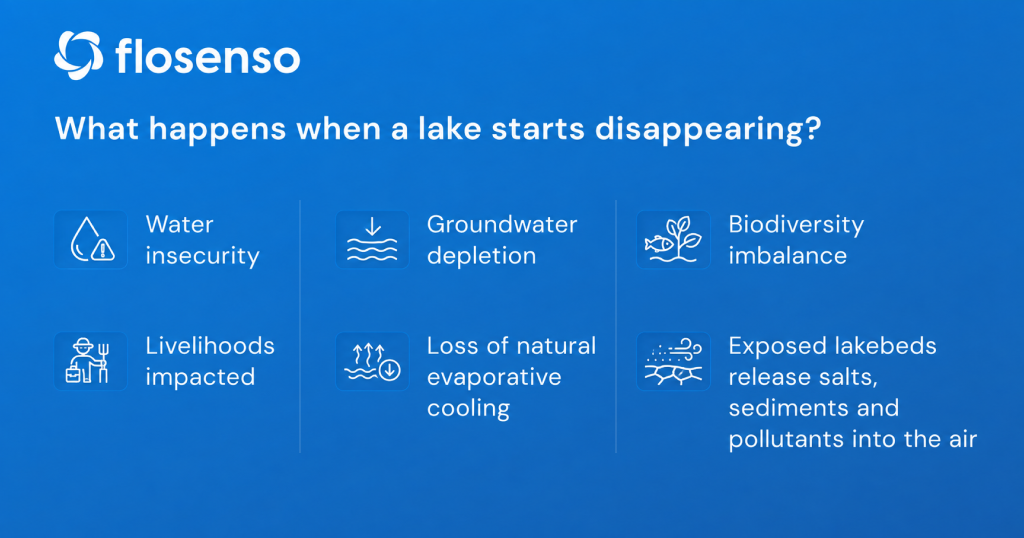
A shrinking lake can affect drinking-water security, groundwater recharge, wildlife, farming, fishing, tourism, local temperatures and even air quality. The effects spread far beyond the shoreline.
Less lake water can push communities towards more groundwater pumping. That, in turn, can place greater pressure on aquifers. Fish populations may decline as water levels and water quality change. Migratory birds lose feeding and breeding habitats. Farmers and fishing communities may lose reliable water and income. Tourism can suffer.
Large water bodies can also help cool their surroundings. When water and surrounding vegetation disappear, that local cooling effect weakens. Then there is the exposed lakebed. As the Great Salt Lake demonstrates, sediments that were once safely underwater can dry out and become airborne.
So, when a lake disappears, we do not simply lose water. We lose a piece of natural infrastructure that was performing many jobs at once.
What do disappearing lakes have to do with the water reaching our homes?
At first, the connection may seem weak. An overflowing tank in an Indian home is obviously not responsible for Lake Urmia shrinking or the Great Salt Lake retreating. Nor should households be blamed for a global water crisis driven largely by agriculture, cities, infrastructure and water policy. But there is still an important connection.
It is about how we value the water that reaches us. By the time water enters a household, it may already have been
Extracted → Treated → Pumped → Transported → Stored
That journey requires infrastructure and energy. Yet the final stage is often still managed by memory. Someone switches on the motor. Then gets busy. The tank fills. Nobody notices. And usable water begins flowing over the terrace.
One overflowing tank will not change a global lake. But preventing that waste is one practical part of household water conservation and water security.
Are drying lakes warning us about something bigger?
Yes. Shrinking lakes show us that water crises usually begin long before the water disappears. We notice the crisis when the signs become dramatic. But the imbalance started years earlier. It began when more water was repeatedly taken than replaced. A shrinking lake is therefore more than an environmental story. It is nature showing us the balance sheet of an overstressed water system.
No household can correct that balance alone. Governments need better water management. Agriculture must become more efficient. Cities need to protect lakes, wetlands and recharge areas. Industries need responsible water use and reuse.
Homes have a role too. Not because shorter showers or automated water tanks will restore the Aral Sea. But because the same principle applies at every level. These efforts matter long after World Water Day conversations end.
Take what you need. Waste as little as possible. Give water systems a chance to recover.

How can Flosenso reduce everyday water waste?
In many Indian homes, managing the water pump still depends on one thing: remembering. Flosenso is designed to remove much of this guesswork. It monitors tank water levels and can automatically control the pump according to configured levels. Through the Flosenso app, users can check tank levels, remotely switch the pump on or off, set schedules and receive alerts.
The idea is to automate routine water management so that preventing waste does not depend entirely on someone remembering to switch off the motor.
Flosenso cannot solve water shortage in India, restore a shrinking lake or fix the global water crisis. That requires action from governments, agriculture, industries, cities and communities. Its role is closer to home. It helps households manage available water more intelligently and reduce avoidable waste.
Frequently Asked Questions
Can groundwater pumping dry up a lake?
Yes. Many lakes and aquifers are connected. Heavy groundwater pumping can lower the water table and reduce the underground water feeding a lake.
Can a lake be unhealthy even when it is full?
Yes. Pollution and nutrient overload can cause algal blooms and oxygen depletion even when water levels look normal. This can damage fish and other aquatic life.
Can dried-up lakes recover?
Some can. Recovery usually requires tackling the original causes, such as excessive water withdrawals, sewage pollution, damaged wetlands or reduced river inflows.
Why are wetlands important for lakes?
Wetlands store rainfall, reduce flooding, filter pollutants and help water recharge into the ground. They also provide important habitat for wildlife.
How does urbanisation affect lakes?
Urbanisation can cover recharge areas with concrete, block natural drainage channels, destroy wetlands and increase polluted runoff. This reduces the amount of rainwater that can replenish groundwater and lakes.