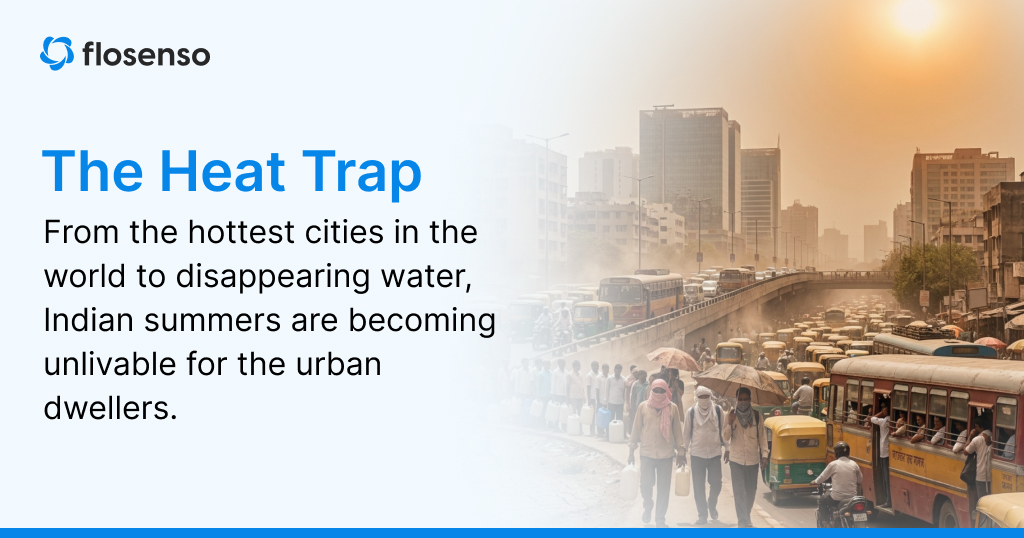
There was a time when an Indian summer meant mangoes and kulfis, afternoon naps, rooftop conversations, and children waiting for evening cricket.
Now?
It means weather apps flashing 47°C before noon. It means roads radiating heat like giant iron plates. It means waking up tired even after sleeping under a fan or AC. Indian summers are beginning to behave like climate emergencies and not seasons.
What makes India the hottest country of the world?
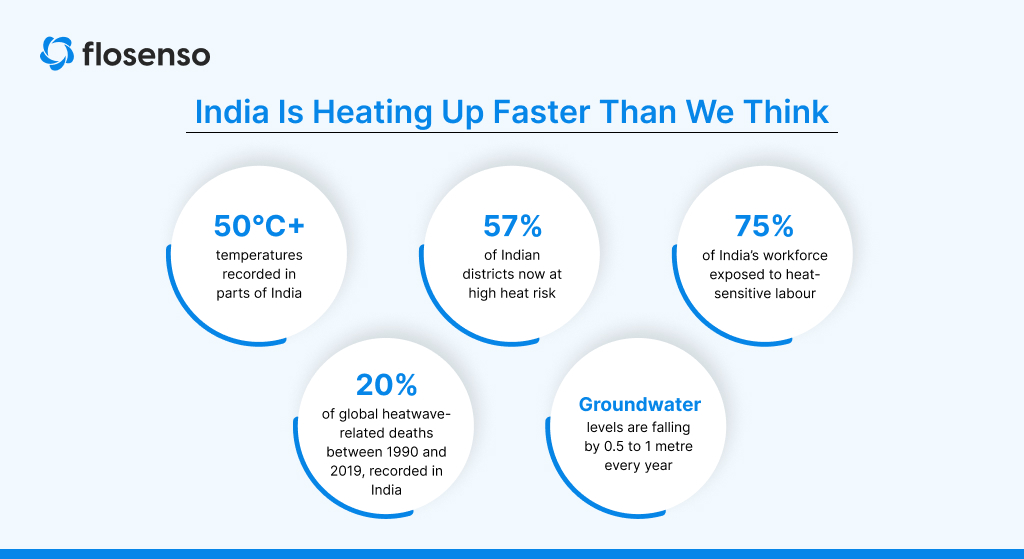
India now tops the list of the hottest country in the world. Indian summers in 2026 are proving to be exceptionally difficult, with many cities recording temperatures near 50°C and over 95 of the world’s hottest cities located in the country, making daily life increasingly hazardous and creating “thermal traps”.
Earlier in 2025 and 2024, parts of India recorded temperatures crossing 50°C. Several Indian cities repeatedly appeared among the hottest locations on Earth during peak summer weeks. The India Meteorological Department also observed a clear rise in the frequency and duration of heat waves India has experienced over the last two decades.
The bigger concern is not just the environmental challenges. It is how Indian cities are trapping, amplifying, and recycling heat. Today, your city is not simply becoming hotter because of climate change. It is becoming hotter because of how it is being built.
That changes everything, how you sleep, work, consume water, use electricity, tolerate the heat.
This is more than an environmental issue. It is becoming an urban survival issue.
Why is the Indian summer getting unbearable?
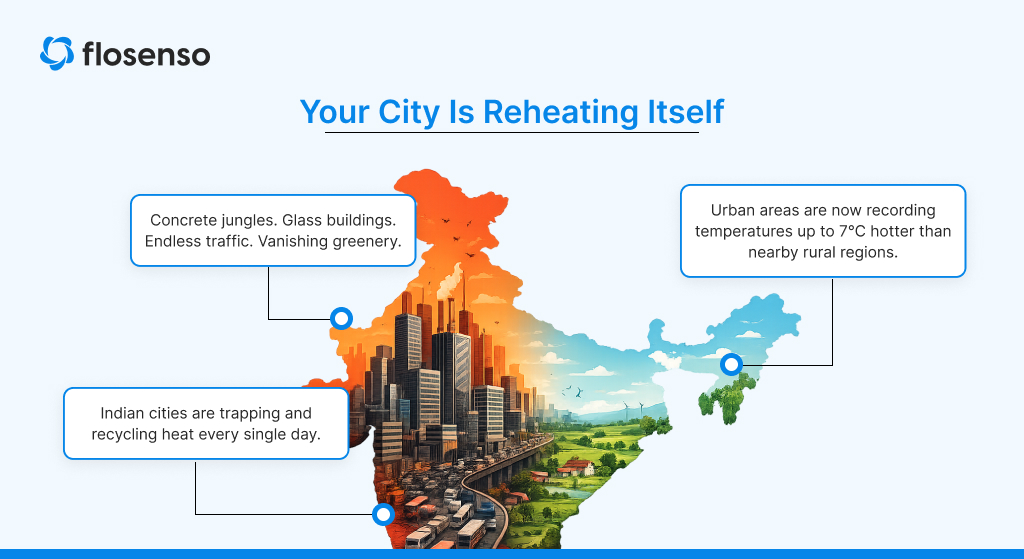
Indian cities are slowly turning into giant thermal traps. Concrete buildings absorb heat all day. Asphalt roads store thermal energy. Vehicles continuously emit waste heat. Air conditioners throw hot air outside. The city keeps reheating itself. This phenomenon is called the Urban Heat Island effect.
Studies now show that dense Indian urban zones can become 3°C to 7°C hotter than nearby rural areas because of rapid urbanisation and shrinking green cover. Research also projects that urban land temperatures in Indian cities could rise nearly 45% more than surrounding non-urban areas if current development patterns continue.
That is alarming. Because India is urbanising rapidly. Urban development researchers estimate that more than 400 million additional people may move into Indian cities between 2014 and 2050. But our cities were never designed for sustained 45–50°C climate conditions.
“India’s cities are absorbing heat at a rate that their colonial-era infrastructure was never designed to handle. The urban heat island effect is not a future problem. It is a present one.” (Climate Risk Assessment, NITI Aayog, 2023)
How is the rising heat affecting Indian cities?
According to the India Meteorological Department, a heat wave is declared in plains when temperatures cross 40°C and remain 4.5°C to 6.4°C above normal conditions. But the real danger today is not only the temperature shown on weather apps. It is the “feels like” temperature. Humidity, pollution, concrete surfaces, and trapped urban heat are making cities feel far hotter than the actual recorded numbers.
Here are some consequences of the extreme heat.
Cities are losing their natural cooling systems
Indian cities have spent decades removing trees, wetlands, open land, lakes, and natural green corridors in the name of rapid urban expansion. Meanwhile, roads, flyovers, commercial towers, parking spaces, and dense concrete housing have expanded aggressively across urban landscapes. As a result, the natural systems that once cooled cities through shade, airflow, and evaporation have slowly disappeared.
Even Delhi, often described as one of India’s greenest megacities, continues to experience hot summers Severe heat waves in Delhi makes residents struggle through their daily chores. This clearly shows that cities cannot survive extreme heat through isolated green patches alone. They need balanced ecological planning integrated directly into urban infrastructure.
Nights are no longer cooling down
Earlier, Indian summers were harsh during the day but relatively cooler at night. That recovery period is now disappearing rapidly. Concrete structures absorb massive amounts of heat during the day and slowly release it throughout the night, keeping urban temperatures elevated even after sunset. Researchers increasingly warn that warmer nights may become more dangerous than daytime heat because the human body loses its natural recovery cycle.
As a result, people experience poor sleep quality, higher cardiovascular strain, mental fatigue, reduced productivity, and slower recovery from heat stress. This is one of the biggest reasons modern Indian summers feel exhausting rather than simply hot.
Heat is worsening the water crisis in India
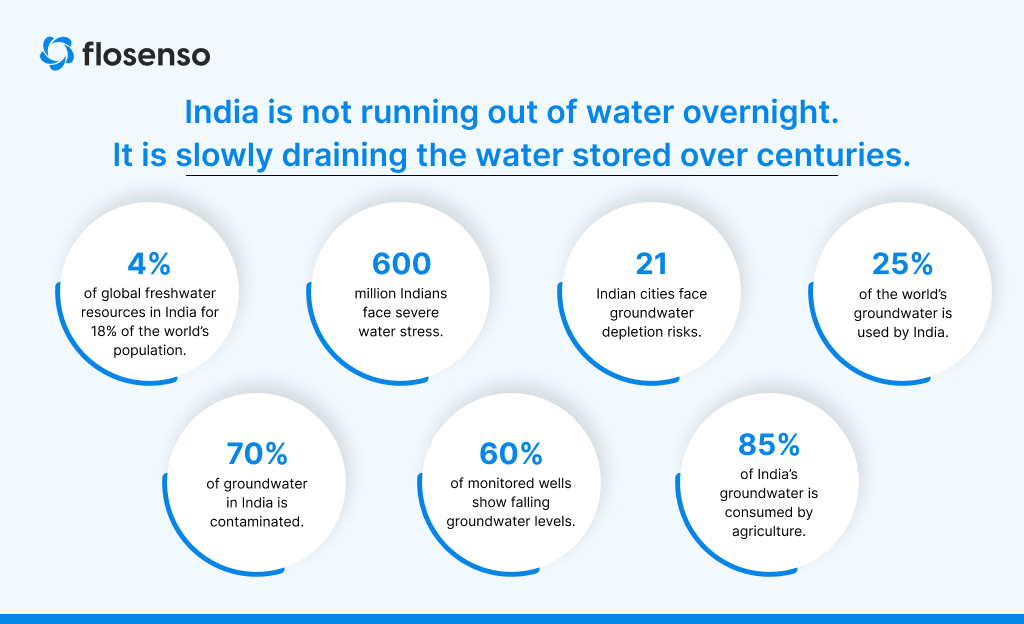
Heat and water are now feeding each other’s crisis in dangerous ways. As temperatures rise, evaporation increases, reservoirs dry faster, urban water demand spikes, and groundwater depletion India continues accelerating. India is already the world’s largest user of groundwater, and NITI Aayog previously warned that nearly 600 million Indians face high to extreme water stress. It also projected severe groundwater depletion risks for several major Indian cities. This directly contributes to worsening water crisis in India, falling groundwater tables, and rising urban stress.
The problem becomes even more dangerous because dry land heats much faster than moist land. In simple terms, once water disappears, cities become even hotter, creating a vicious cycle of heat and resource depletion.
The poor are paying the highest price
Extreme heat in India does not affect everyone equally. Construction workers, delivery riders, sanitation staff, migrant labourers, and street vendors spend long hours outdoors under direct heat exposure while also living in tin-roof homes, poorly ventilated settlements, and heat-retaining structures. Census-linked urban studies showed rural-to-urban migration rising from 51.6 million people in 2001 to 78.2 million in 2011, while slum populations increased sharply during the same period. These densely packed settlements often become the worst thermal zones inside cities.
According to the Council on Energy, Environment and Water (CEEW), nearly 57% of Indian districts are now categorised as high to very high risk from extreme heat. The India Meteorological Department recorded more than 10,500 heat-related deaths between 2000 and 2020. However, experts believe the real number is likely much higher because cardiovascular complications, respiratory illnesses, and dehydration-linked deaths are often not officially classified as heat-related fatalities.
Heat is damaging India’s economy
Extreme heat is no longer only making cities uncomfortable. It is directly reducing economic productivity across India. The World Bank estimates that nearly 75% of India’s workforce depends on heat-exposed labour, making the country especially vulnerable to rising temperatures.
Outdoor workers are increasingly losing productive hours because afternoons are becoming unsafe for physical activity. Street vendors report faster spoilage of fruits and vegetables, cab drivers struggle between fuel costs and running air conditioners, and small shop owners often shut businesses during peak afternoon heat. Over time, these disruptions affect incomes, productivity, healthcare costs, and urban economic resilience. Indian summers are now creating measurable financial stress alongside environmental damage.
Indian summers are now directly affecting economic resilience.
What keeps rural India cooler but heat stressed?
Rural India is also being affected by climate change. However, villages still remain relatively cooler compared to major cities because they continue to retain parts of nature’s original cooling infrastructure. Open land, agricultural fields, trees, water bodies, better airflow, and lower concrete density allow heat to escape more naturally. Unlike cities that trap heat inside concrete and asphalt surfaces, rural environments still release a significant portion of it back into the atmosphere. That is the biggest difference between urban and rural heat conditions today.
However, rural India faces another side of the crisis. It is dealing heavily with crop failures, drought, water scarcity in India, reduced soil moisture, and worsening groundwater depletion India. Farmers are increasingly struggling with falling agricultural yields because crops cannot tolerate prolonged heat stress and unpredictable rainfall patterns. So while urban India suffers from trapped heat and thermal stress, rural India is fighting climate instability and water insecurity. In reality, the country is now battling two deeply connected climate crises at the same time.
What must India do to cool down its cities?
Despite the environmental challenges, India cannot solve this crisis with temporary fixes alone. Cities need structural cooling strategies. Here are some ways to do it.
Protect and restore water bodies
Urban lakes, wetlands, ponds, and recharge zones must be restored. Water naturally cools surrounding environments through evaporation. Rain water must be tapped and harvested to restore ground water levels. We need to respond actively and take measures to control the reasons for water crisis in India.
Increase connected green infrastructure
Cities need tree corridors, urban forests, shaded streets, public green spaces, and not isolated plantation drives.
Build heat-resilient infrastructure
Cool roofs, reflective paints, ventilated buildings, shaded bus stops, and heat-resistant urban materials should become standard.
Improve urban planning
Future city planning must prioritise airflow, water recharge, reduced heat absorption, sustainable living infrastructure. Address the reasons for water scarcity in India with sound groundwork and action. Make rainwater harvesting a compulsory act.
Adopt sustainable lifestyle
Every year the World Water Day arrives with its hashtags, its reports, and its well-intentioned campaigns. But what the World Water Day often fails to translate into is household-level urgency and need for sustainable lifestyle. For years, sustainable living was treated like a lifestyle trend. Reusable bottles. Indoor plants. Eco-friendly shopping bags. But the current Indian summer is exposing a much bigger truth.
Sustainability is about survival infrastructure. Every overflowing water tank, disappearing lake, unnecessary unit of electricity matters. Each leaking pipe, and inefficient pumping system adds pressure to the water crisis in India. Sustainable living and smart water management is the need of the hour.
Smart thinking can cool down the India of the future
The Indian summer is not waiting for policy. It is accelerating on its own schedule, driven by forces that outlast any election cycle. The response cannot only be governmental, it must be household-level, building-level, and neighbourhood-level. Sustainable living means closing the gap between what systems promise and what they actually deliver.
Every heatwave now feels like a warning. And unless Indian cities rebuild their relationship with water, energy, ecology, and infrastructure, extreme heat in India will continue reshaping daily life.
The future of Indian cities will not depend only on how much we build. It will depend on how intelligently we live.

What is the role of Flosenso in sustainable living?
As Indian summers grow harsher and water shortage in India intensifies, smarter homes will become critical to sustainable urban living. That is where Flosenso is quietly becoming relevant.
Built by Energy Bots Pvt. Ltd., Flosenso is an IoT-enabled smart water automation system designed to reduce water wastage caused by overflowing tanks, dry-running motors, and inefficient pumping habits. Using ultrasonic sensing, app-based controls, scheduling, and intelligent automation, Flosenso helps households manage water more responsibly.
In a country battling groundwater depletion India and increasing urban heat stress, smarter water usage is becoming an essential infrastructure requirement for sustainable living.
Because every litre saved today is part of tomorrow’s climate resilience.