Every Earth Day, the narrative feels familiar. We talk about sustainability, climate change, and the responsibility we all share toward the planet. There’s awareness, there’s intent, and there’s a collective sense that something needs to change.
And yet, when it comes to water, most of us still find ourselves in a passive role… waiting for better infrastructure, more reliable supply, or stronger policies to solve the problem for us. It feels logical. After all, water scarcity seems like a large-scale issue, something that governments and institutions should handle.
But where does our role come into force? Are we not responsible? While systems are being planned and pipelines are being expanded, water is already being lost. Quietly, consistently, and often within the four walls of our own homes.
So, this World Earth Day, the conversation needs to change. Not “Who will solve this?” But “What am I doing about it?” Let us explore the possibilities.
What is the significance of Earth Day?
For years, Earth Day celebration focused on building awareness, and rightly so. People needed to understand the scale of environmental challenges, and water conservation was part of that conversation. Today, however, awareness is no longer the problem. Most people understand that water is finite. Most people agree that wastage is harmful. Yet, despite this awareness, the behaviour hasn’t changed enough to create meaningful impact. That is because the real challenge is no longer knowledge, but ownership.
The numbers are already alarming. India is home to nearly 18% of the world’s population but only 4% of its freshwater resources. At the same time, NITI Aayog has warned that 21 major Indian cities could run out of groundwater entirely, impacting over 100 million people.
The real question is, who owns the solution? Governments can build pipelines. They can expand supply. They can regulate usage at a macro level. But they cannot control how water is used inside your home.
They cannot stop your tank from overflowing.
They cannot monitor your water consumption.
They cannot fix a leaking tap in your bathroom.
And that’s where the real problem lies. These are not policy failures; they are gaps in everyday management. And unless that ownership shifts to individuals, the larger systems will always remain under pressure.
Water is a privilege on Earth
If you step outside your daily experience, the reality of water begins to look very different. Across the world, more than 2 billion people still lack access to safely managed drinking water, and nearly 1 in 4 households depend on sources located outside their homes. This is not just an inconvenience, but a daily burden.
In many parts of the world, particularly in developing regions like South Asia and Africa, the responsibility of collecting water falls disproportionately on women and girls. They spend over 200 million hours every day walking to distant sources, often under unsafe conditions, carrying heavy loads just to meet basic household needs. This time comes at the cost of education, economic participation, and personal safety.
Now contrast that with the convenience of turning on a tap at home. The difference is stark. And it forces an uncomfortable but necessary reflection. Water, for many of us, is not just accessible; it is taken for granted.
Your home is a mini water system. Are you managing it well?
Most people don’t think of their home as a water system, but that is exactly what it is.
Water enters your home through a supply source, gets stored in tanks, flows through a network of pipes, and is eventually consumed or discharged. At every stage, there is potential for efficiency or loss.
The challenge is that, unlike electricity or fuel, water usage is rarely measured in a way that creates urgency. There is no monthly shock that forces you to rethink your consumption. Instead, water loss remains largely invisible. But the data tells a different story.
- A single dripping tap can waste over 11,000 litres per year
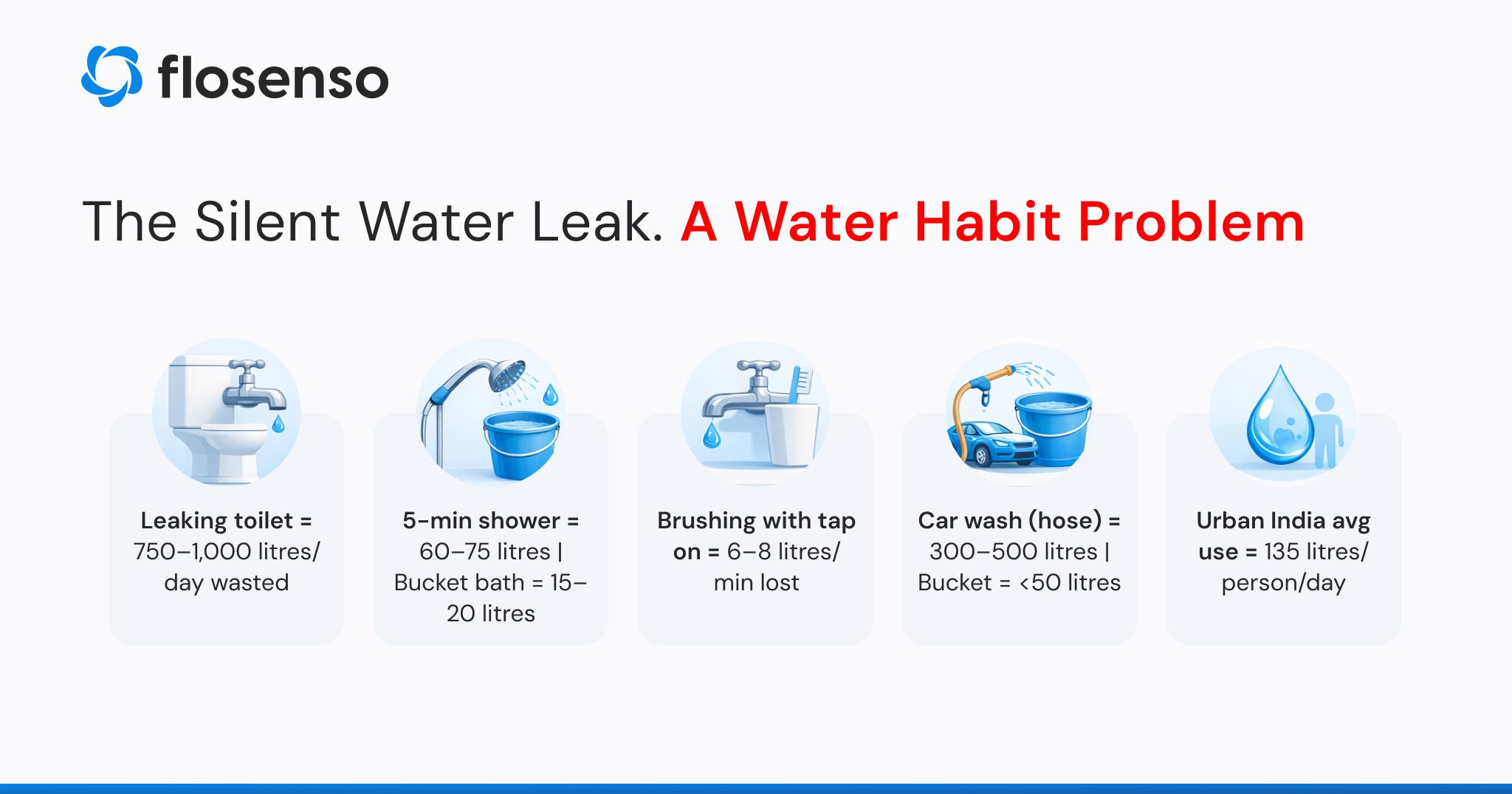
- A running toilet leak can waste up to 750 litres per day
- Urban India loses nearly 30–40% of its water supply due to leakages and inefficiencies
Now add household-level inefficiencies like overflow and overuse.
- A tap that drips overnight does not demand attention.
- A tank that overflows for ten minutes goes unnoticed.
- A motor that runs slightly longer becomes a habit.
Over time, these small inefficiencies compound into significant wastage. And because there is no immediate feedback loop, the system continues to operate inefficiently without intervention. This is precisely why managing your home as a system, not just a space, becomes critical.
How to save water begins with what you already have
When people search for how to save water, they often expect complex solutions or large lifestyle changes. The most effective changes are simple, immediate, and entirely within your control. It starts with addressing what is already broken.
Fixing leaks may seem basic, but it is one of the most impactful steps you can take. A single dripping tap can waste several thousand litres of water in a year, and yet it is often ignored because the loss feels insignificant in the moment.
Beyond repairs, daily habits play an equally important role. Leaving the tap running while brushing, taking longer showers than necessary, or running appliances without full loads may seem convenient, but they gradually inflate your water footprint.
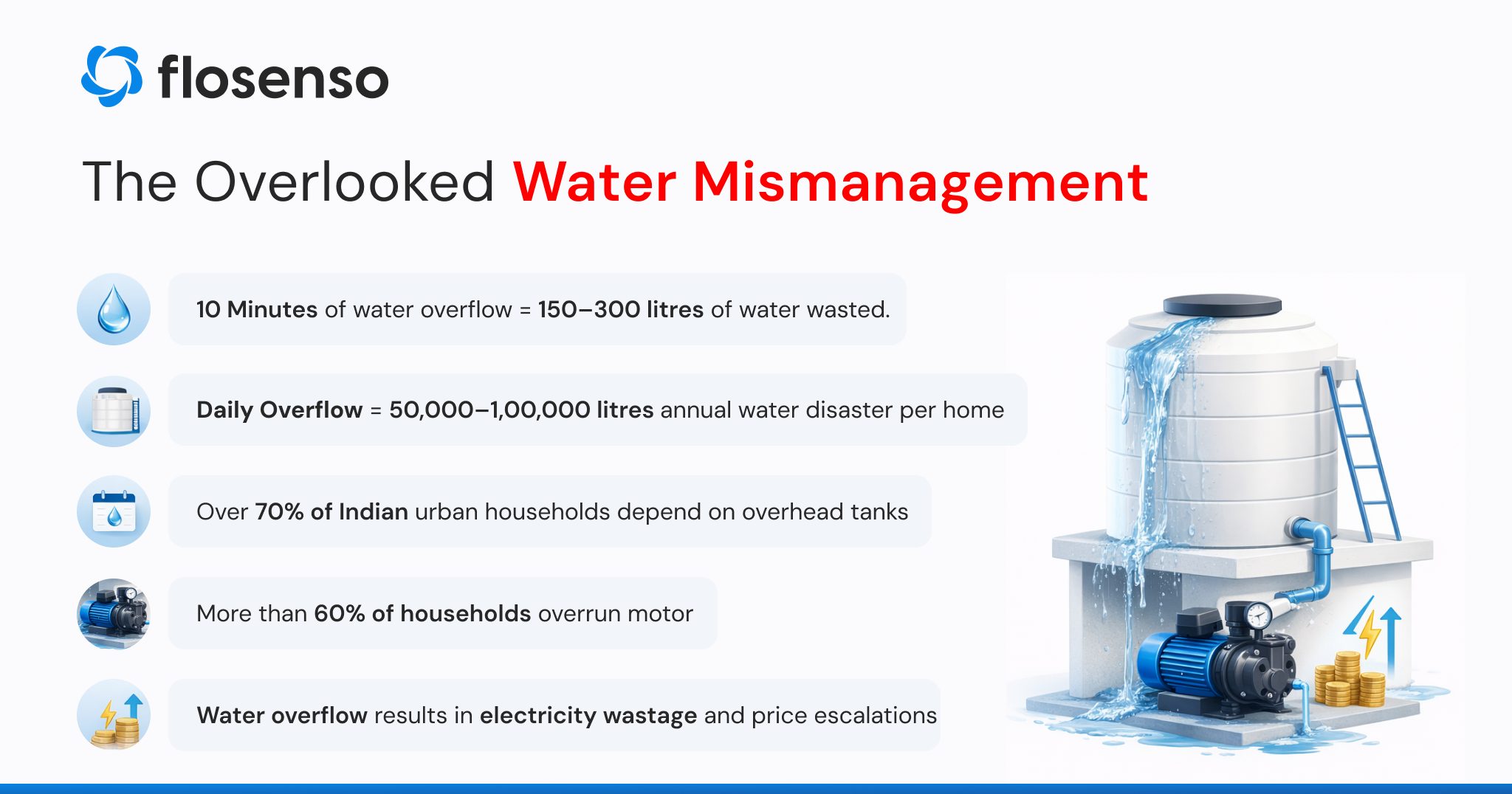
- A 10-minute tank overflow can waste 150–300 litres depending on flow rate
- If this happens daily, it can lead to 50,000–1,00,000 litres wasted annually per household
- Nearly 70% of urban homes in India rely on overhead tanks, increasing risk of unnoticed overflow
- Manual motor operation leads to over-pumping in 60%+ households (industry estimate)
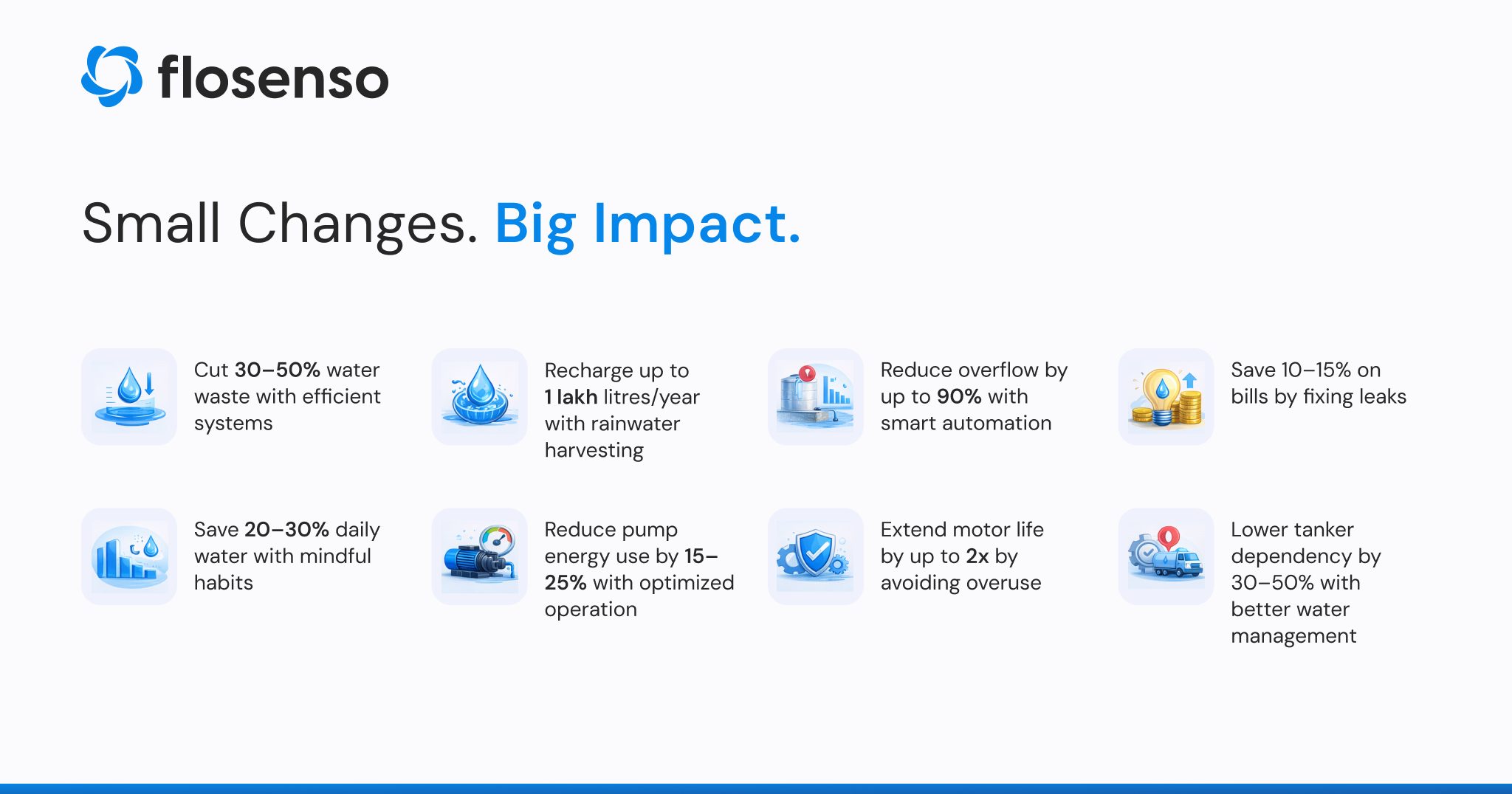
You can fix these. They do not ask for lifestyle sacrifices. They are behaviour corrections. And they work.
The encouraging part is that households that consciously adopt efficient habits can reduce their water usage by 30–40%. That is not a marginal gain, it is a fundamental shift in how water is consumed.
Eco friendly home ideas that go beyond the obvious
When we talk about eco friendly home ideas, the assumption is often that sustainability requires investment or structural changes. However, some of the most effective ideas are rooted in better utilisation of existing resources.
Reusing water is a simple yet powerful concept that remains underutilised in most households. RO systems typically waste 2–3 litres of water for every litre purified. That rejected water doesn’t have to go down the drain. It can be reused for cleaning, gardening, or washing.
Similarly, water used for washing fruits and vegetables can be redirected toward gardening. Even the initial cold water that runs while waiting for a shower to warm up can be collected and reused.
These actions may appear small in isolation, but they fundamentally change how water is perceived. Not as a disposable resource, but as something that can be extended, reused, and managed more intelligently within the same household.
Rainwater harvesting systems and the bigger picture
At a certain point, conservation alone is not enough. It needs to be complemented by contribution. This is where rainwater harvesting systems become essential. By capturing rainwater from rooftops and directing it into storage systems or recharge pits, households can actively participate in replenishing local water resources.
India receives an average annual rainfall of around 1,170 mm, yet a significant portion of this water is lost due to poor capture and storage systems.
By installing rainwater harvesting, homes can:
- Reduce dependence on municipal supply
- Recharge local aquifers
- Improve the groundwater level, which is declining rapidly in urban areas
Cities like Chennai have demonstrated the effectiveness of widespread rainwater harvesting, where policy and citizen participation together have led to measurable improvements in water availability.
The significance of such systems lies not just in reducing dependency on external or municipal supply, but in creating a more resilient and self-sustaining water ecosystem at a local level.
The hidden water footprint in everyday choices
Water consumption is not limited to what flows through your taps. It is embedded in the products you use and the choices you make.
Water is embedded in everything you consume.
- Producing 1 kg of beef requires nearly 15,000 litres of water
- A single pair of jeans consumes approximately 10,000 litres
- Producing 1 kg of rice requires 3,000–5,000 litres of water
- 1 cup of coffee requires around 140 litres of water
- 1 litre of milk requires approximately 1,000 litres of water
- Even electricity production uses around 140 litres of water per kWh globally
These numbers reveal the concept of a hidden or indirect water footprint, one that is rarely visible but highly impactful. When you choose to consume less, reuse more, or opt for sustainable alternatives, you are effectively reducing this hidden footprint.
This expands the idea of water conservation beyond direct usage and integrates it into broader lifestyle decisions.
Harnessing community power to protect our planet’s future
While individual action is critical, its impact multiplies when communities come together. A single household conserving water creates change at a micro level, but a community doing the same can influence entire ecosystems. When residential societies adopt rainwater harvesting, fix systemic leaks, and promote awareness collectively, the reduction in water wastage becomes substantial.
This is what harnessing community power to protect our planet’s future truly represents, shared responsibility leading to amplified impact. It is also where Earth Day celebration evolves from a symbolic gesture into a sustained movement. Real change is rarely the result of isolated efforts; it is the outcome of consistent, collective action over time.
This Earth Day, rethink your role
This World Earth Day, the expectation is not to do something extraordinary. It is to become more aware of what is already within your control. The biggest water losses are not dramatic events; they are small, repetitive actions that go unnoticed. And because they go unnoticed, they continue unchecked. The shift, therefore, is not about adding more effort, but about bringing visibility and intention into everyday behaviour. Once you begin to see your role clearly, the idea of waiting for external solutions starts to feel unnecessary.
Water conservation is often framed as a global challenge, but its solution is deeply personal. It lies in how you manage what you already have. It lies in fixing what is broken, rethinking what is habitual, and optimising what is overlooked. When enough individuals adopt this approach, the impact scales naturally, from homes to communities to cities. The truth is simple yet powerful: water does not need more awareness. It needs better management. And that management begins with you.
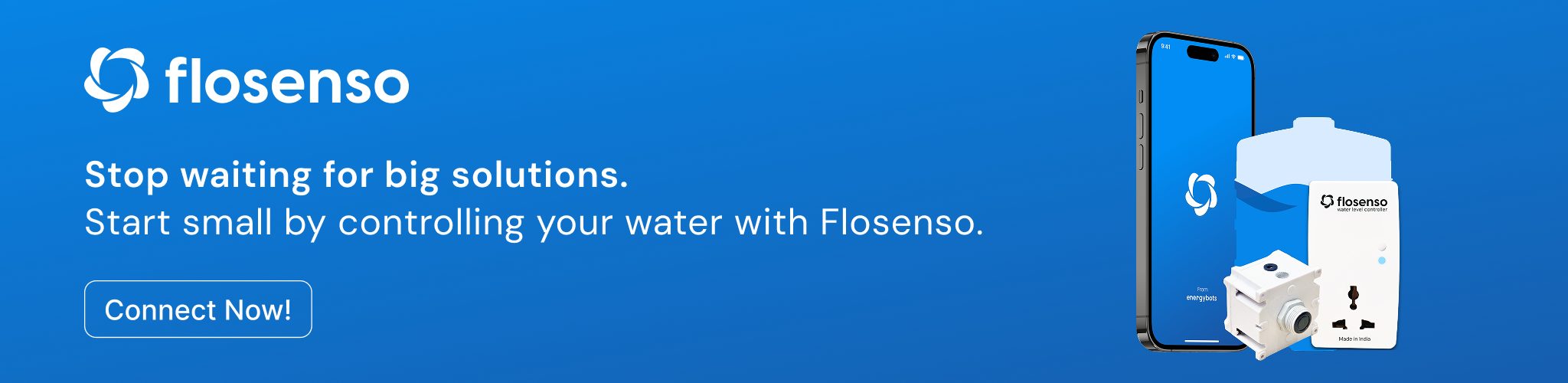
Flosenso - Bringing intelligence to everyday water use
In most households, water management is still manual and reactive. You switch on the motor, estimate when the tank might be full, and hope you remember to turn it off in time. This dependence on memory creates inconsistency, and inconsistency leads to wastage.
Solutions like Flosenso smart water level controller address this exact gap by introducing automation and visibility into everyday water usage. By monitoring tank levels in real time and controlling pump operations automatically, Flosenso eliminates overflow, prevents dry runs, and ensures that water is used precisely as needed. More importantly, it transforms water management from a manual task into a reliable system. This aligns closely with the broader goal of sustainable living, where efficiency is not driven by effort alone but by intelligent systems that make the right decisions consistently. In that sense,
Flosenso is not just a product. It is a step toward making responsible water usage a default behaviour in modern homes.
The Earth doesnt need us. We need the Earth to live on. Do your best to keep it green and blue!